| Characteristic | Details |
| Size | Large |
| Build | Long and powerful |
| Coat length | Medium-long |
| Shedding level | Moderate to high |
| Energy level | Moderate to active |
| Life expectancy | 12 to 16 years |
| Best suited for | Families, children, other pets and apartment living |
The Norwegian Forest Cat, also known as the “Skogkatt”, is a natural breed from Scandinavia. According to popular accounts, its ancestors were introduced to the Nordic countries by Vikings through trade routes connecting Scandinavia and the Middle East.
Deeply rooted in Norse mythology, the Norwegian Forest Cat has long been associated with large, hardy cats capable of thriving in cold climates and dense Scandinavian forests. Modern breeding efforts began in the 1930s, and the breed was officially recognised in the 1970s under the name “Skogkatt,” which literally means “forest cat.”
Today, the Norwegian Forest Cat is admired both for its majestic appearance and its balanced, people-oriented temperament.
The Norwegian Forest Cat is generally known for being gentle, calm and well-balanced. Despite its impressive size and rugged origins, it has an affectionate and sociable nature that makes it a wonderful companion.
Deeply attached to its family, it enjoys being around its humans while maintaining a degree of independence. It likes to be involved in daily life, observe its surroundings and play on its own terms without constantly demanding attention.
Playful when the mood strikes, it is also remarkably gentle and usually gets along well with children and other pets when properly socialised. Intelligent and curious, it thrives in environments that offer climbing opportunities, cat trees and plenty of enrichment.
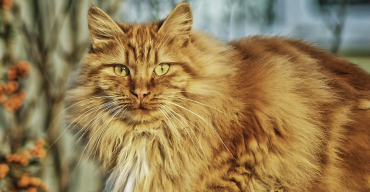
The Norwegian Forest Cat is a large and powerful cat with a solid frame and a long, muscular body. Its triangular head, large ears often tipped with lynx-like tufts and long bushy tail give it a distinctive and striking appearance.
Its double-layered medium-long coat is perfectly adapted to cold climates. A dense, woolly undercoat is covered by a smoother, water-resistant outer coat that helps protect against moisture and harsh weather. A full ruff around the neck further enhances its majestic look.
The breed comes in a wide range of colours and patterns. Despite its abundant coat, grooming is relatively manageable, with weekly brushing being sufficient most of the time. During seasonal shedding periods, more frequent grooming is recommended to prevent tangles and remove loose hair.
The Norwegian Forest Cat is generally regarded as a hardy and resilient breed. It develops slowly compared to many other cats, with full physical maturity sometimes taking several years to achieve.
As with many large cat breeds, maintaining a healthy weight and providing a high-quality diet are important for supporting long-term joint health and mobility. Certain hereditary conditions may also occur depending on the bloodline.
Regular veterinary check-ups, up-to-date vaccinations and a healthy lifestyle play an important role in preserving overall wellbeing. Its thick coat also requires routine maintenance to prevent matting, especially during shedding seasons.
Although it can adapt well to apartment living, the Norwegian Forest Cat remains an active cat that benefits from an enriched environment with cat trees, elevated spaces and daily play sessions to support both physical and mental wellbeing.